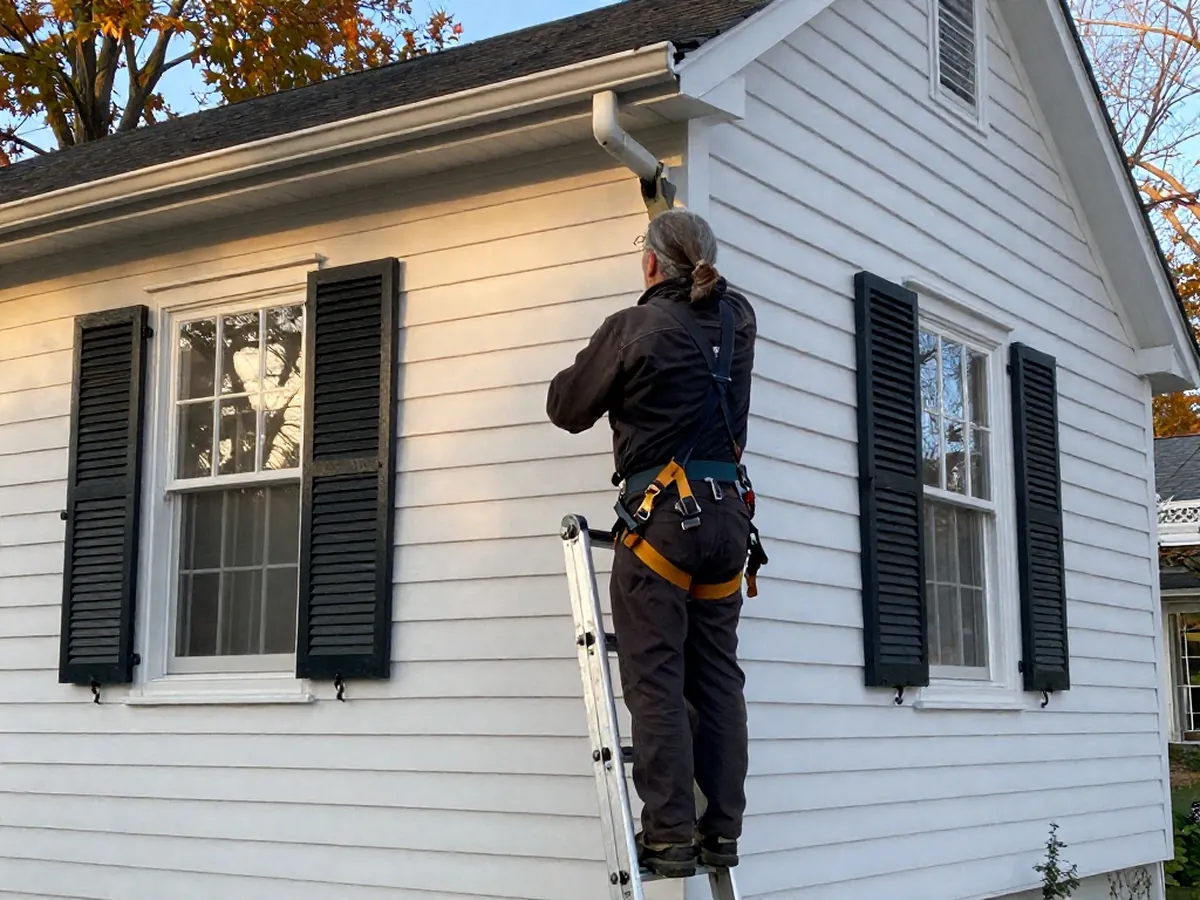
Start on the ground, not the ladder
NIOSH ties more than 100 deaths a year to ladder falls. Its advice is short: firm, level ground, a ladder tilted at about 75 degrees, three points of contact, and ten feet from any power line. A walk-around needs none of that. Binoculars, a phone and an upstairs window cover almost everything below. If a wire is down or hanging anywhere in view, keep 30 feet clear and report it to 911 or the utility; PSE&G and FirstEnergy agree on the distance.
The asphalt roofing trade group gives the same order after a storm: the ground first, then the attic. Pick a dry day with decent light, and let the date stamp on your photos do the remembering.
Stops one to three: what the shingles say
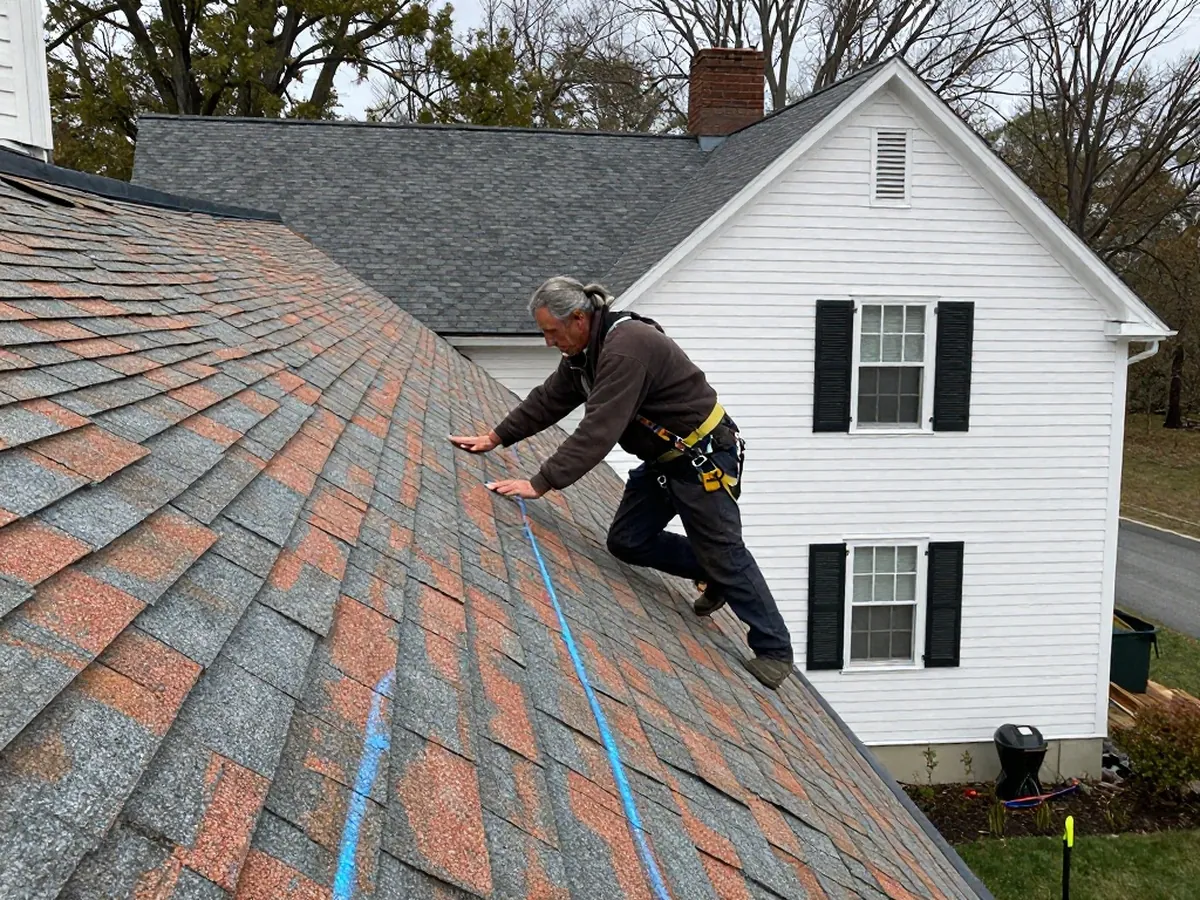
Stop one is the roofline from the street. A sag, a ridge that has lost its line or a patch that looks a different shade deserves a photo. Stop two is the shingle field, one slope at a time, for curled corners, bare patches and gaps in the pattern. Stop three is the gutters and the feet of the downspouts, where sand and grit show up as the surface wears.
The Department of Energy's repair brief offers a yardstick worth carrying: when upwards of a tenth of a roof needs work, a new roof is the advice. The walk gives you a rough count of how much you are looking at.
Stops four to six: the places metal does the work
Stop four is the chimney, where the Department of Energy lists base flashing, step flashing and counterflashing. Stop five is every spot where a roof runs into a wall; step flashing there goes in pieces, at least 4 inches up the wall and 4 along the roof deck. Stop six is the valleys and the vent pipes, which the same agency calls the most vulnerable parts of a water-managed roof.
Binoculars pick out rust, lifted strips and gaps at the brick. A bead of old tar around a joint means somebody has patched it before, and a roofer will want to hear that.
Stops seven and eight: where the water leaves, and the attic
Stop seven follows the water out. Look along each gutter run for sag and see where every downspout empties. The EPA suggests sending that water to a rain barrel or onto soil, and Rutgers works out that an 800-square-foot roof sheds about 500 gallons to a single downspout when an inch of rain falls.
Stop eight is the attic, from the hatch with a flashlight: look along the roof boards for daylight, dark streaks, frost and damp insulation. Stay on the ladder, since the ceiling below was not built to carry a person.
Twice a year, and after a blow
FEMA's roof fact sheets advise a look at least twice a year, in spring and fall, and again after high wind. At the Somerville airport station the low reaches freezing on about 124 days a year, 19.2 of them in March and 16.1 in November, so spring and fall bracket the cold stretch.
Take the same photos from the same spots each time, with the date. Put side by side, they show a slowly lifting corner that memory would have smoothed over.
When does a walk-around turn into a phone call?
A stain that grows, shingles on the lawn, a gap at the chimney or damp insulation in the attic is enough. Match the sign to a page: roof leak repair for stains and drips, flashing and chimney leaks for the metal.
Call (908) 827-6709 and describe the stops where you saw something. If the house is rented, the photos go to the owner, who arranges the work.
The walk on one card
- Roofline from the street: sags, a crooked ridge, patches of a different shade
- Shingle field, slope by slope: curled corners, bare patches, gaps in the pattern
- Gutters and downspout feet: shingle grit and sand
- Chimney: gaps at the brick, rusty or lifted metal, old tar
- Wall joints: metal visible and lying flat against the siding
- Valleys and vent pipes: cracks, lifted edges, stains inside the house
- Gutter runs and downspout landings: sag, pooling, gouged soil
- Attic from the hatch: daylight, dark streaks, frost, damp insulation
Where this comes from (12)
- NIOSH, Ladder safety (reviewed 1 Mar 2024)
- Asphalt Roofing Manufacturers Association, Assessing roof damage after Superstorm Sandy (7 Nov 2012)
- FEMA, Fact Sheet 3.3.1: Roof Systems, Sloped Roofs (Mar 2022)
- U.S. Department of Energy, Handy Homeowner technical brief: Repairing Roofs and Ceilings (Jan 2006)
- U.S. Department of Energy, Building Science Education, Water-managed roof assembly
- U.S. Department of Energy, Building Science Education, Step flashing at roof-wall intersections
- U.S. Department of Energy, Building Science Education, Waterproofing chimneys
- U.S. EPA, Soak Up the Rain: Disconnect and redirect downspouts
- Rutgers Water Resources Program, Rain barrels
- PSE&G, Downed power lines
- FirstEnergy, Downed power lines
- NOAA National Centers for Environmental Information, 1991-2020 monthly normals, Somerville Somerset Airport (USW00054785)
Checked 1 Nov 2026