When patches stop holding on Warren-area roofs
Reroofing in Warren, NJ
Reroofing in Warren, NJ means taking off the old covering, looking over the boards beneath and putting a new one down, a step that comes up when repairs keep piling up.
Call (908) 827-6709 with the roof's age and its trouble spots, and the contractor can explain the choices.
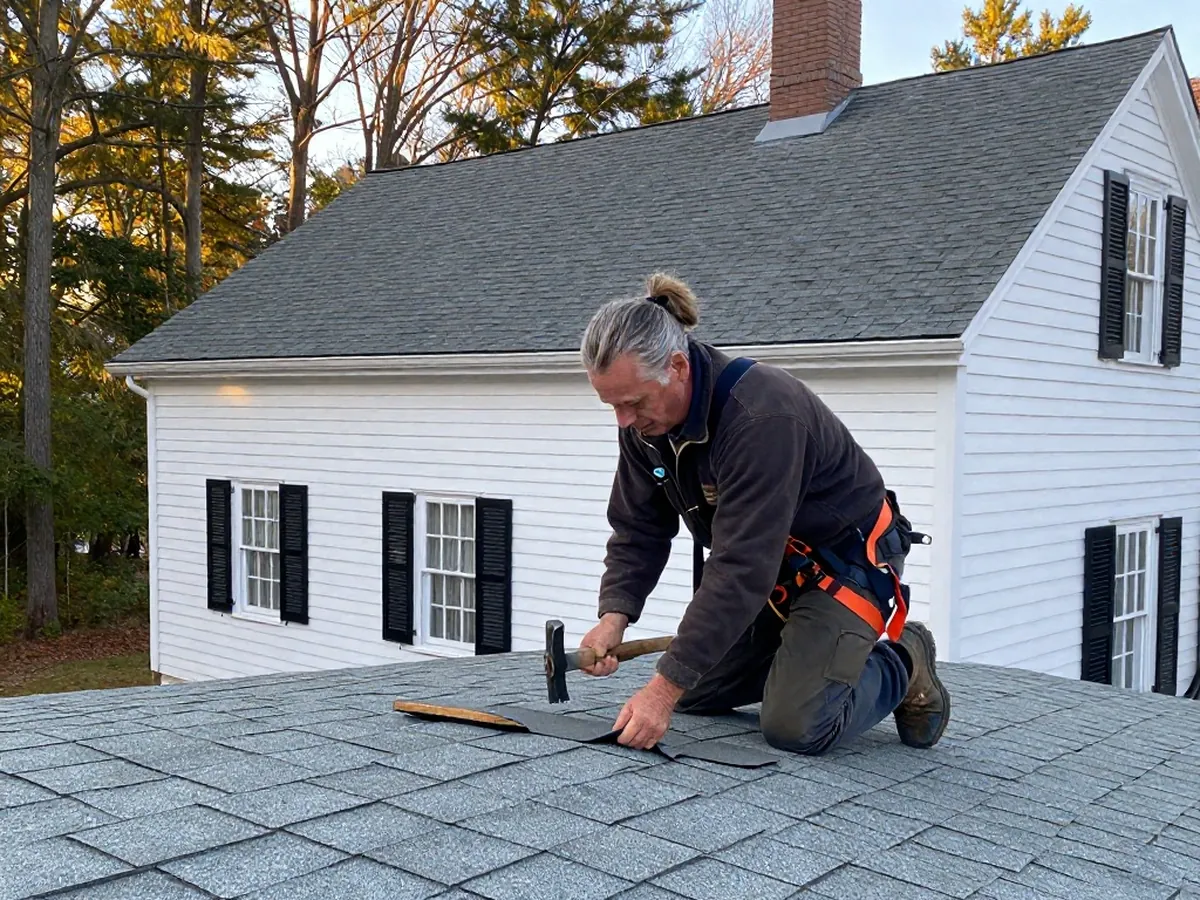
What the contractor can look at
Call (908) 827-6709, give the roof's age and where it fails, and the contractor can arrange a visit.
- The contractor can count the layers of shingles along an edge and judge how worn the surface is.
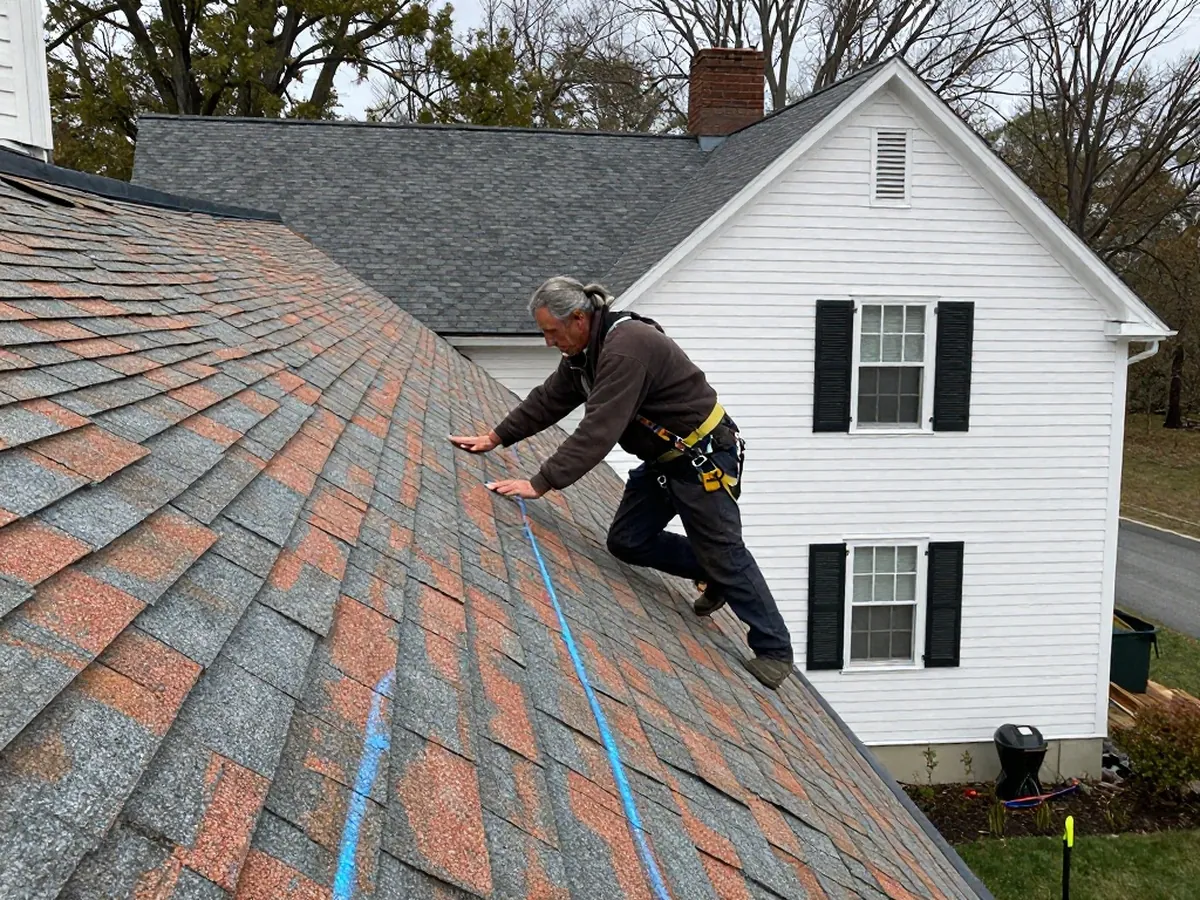
- Chimneys, valleys, vents and the eaves can be checked for the flashing and drip edge they need.
- The deck can be checked for soft or stained boards that would be replaced during a tear-off.
- Material choices and what goes under them, including the underlayment, can be explained side by side.
- The written scope can list materials, steps, start and finish dates, and who handles the debris.
Looks from the ground
Stick to what the lawn, an upstairs window or the attic hatch shows. A ladder, or a walk over the shingles, is a roofer's job.
- Count the trouble spots from the yard: bare patches, curled edges and stains in more than one room. One spot points to a repair, several point toward a bigger job.
- Find the age. An old invoice, a folder from the previous owner or a note in the closet may give the year the roof went on.
- Check the gutters and the foot of each downspout for sandy grit. A lot of it says the shingle surface is wearing out.
- Photograph each slope from the ground in daylight, so the pictures can be compared when quotes arrive.
Step back and get help if
- A ceiling that sags or bulges under a leak is carrying weight: clear the room below and call 911.
- A wire sagging from the pole to the roofline or lying on the lawn: keep at least 30 feet away, treat it as live, and tell 911 or your electric company (PSE&G 1-800-436-7734, JCP&L 1-888-544-4877).
- Water reaching a light in the ceiling or a socket in the wall: leave that room, touch no switches and call 911 from somewhere dry.
- A bare roof with rain on the way: do not climb up to cover it yourself. Call the contractor, and call 911 if someone falls.
Questions to put to a roofer
Questions to put before a tear-off starts
Ask how many layers will come off and what happens if soft boards turn up underneath. Ask what goes down between the deck and the new shingles.
Ask who handles the dumpster, the debris around the house and the cleanup. Ask for start and finish dates and for the payment schedule, in writing, with any change to either one also written down.
About the picture
In the picture: half a roof down to the boards
The scene shows the middle of a tear-off. Old shingles are gone from one side, the bare deck is visible, and the crew is rolling out underlayment before any new shingle goes on. A dumpster at the curb takes the old material.
That bare-deck moment is when soft or stained boards show themselves. The picture is a rendering, not a photograph of a real job.
Questions this job raises
Where does an aging roof land on a 1-to-10 scale?
A roof that is open to the weather, with shingles gone from a slope, water through a ceiling or a wire down, is an 8 to 10: make the area safe and reach 911 or the utility. Spreading stains or shingles shedding grit make it a 4 to 7, and call (908) 827-6709 this week. A roof that looks tired but stays dry is a 1 to 3, a good moment to photograph it, note its age and plan ahead.
When does replacement make more sense than repair?
The Handy Homeowner repair brief repeats a trade-journal rule of thumb: if over 10 percent of the old roof calls for work, the advice is a new roof. It is a yardstick, not a verdict. What the roofer finds on the deck and around the flashing settles it.
What goes down under the new shingles?
FEMA's sloped-roof fact sheet says that when the whole covering comes off, an upgraded underlayment goes on before the new one, and it lists drip edges at the eaves among the details. For all wood nailing it calls for nails with ridged shanks. Those are fair items to find in the written scope.
What goes into a roofing contract?
New Jersey asks for a written contract on home improvement work over $500, one that names the seller, the work and its main materials, the price, and when the work starts and finishes. Changes go in writing as well. The hiring checklist walks through the rest.
Does reroofing cover the neighboring towns too?
Yes. Reroofing is available through the contractor in Warren roofing, Watchung roofing, Green Brook roofing, Bridgewater roofing, Bernards roofing and Long Hill roofing. Name your street and the roof's age when you call (908) 827-6709.
Parts of the roof involved
What a full replacement touches, layer by layer
Four things change on a replacement: the shingles, the underlayment beneath them, the flashing at chimneys, walls and valleys, and any deck boards found soft. Metal drip edge along the eaves is part of the edge detail.
FEMA's sloped-roof fact sheet describes flashing that is integrated with the shingles and the underlayment, rather than added on top. Ridge caps and vents finish the job at the top of the slope.
Paperwork, briefly
Replacement and the state's ordinary-maintenance list
The state's March 2018 alert reads "including total replacement" when existing roof covering is repaired or replaced on a detached home for one or two families. A full re-roof of that kind is listed as ordinary maintenance. Not every town page agrees. Bridgewater's page ties a residential roofing permit to replacing roof sheathing. The hiring checklist sets out the six offices.
Where this comes from (7)
- U.S. Department of Energy, Handy Homeowner technical brief: Repairing Roofs and Ceilings (Jan 2006)
- FEMA, Fact Sheet 3.3.1: Roof Systems, Sloped Roofs (Mar 2022)
- Cornell LII, N.J.A.C. 13:45A-16.2, Home improvement contracts
- NJ Department of Community Affairs, Ordinary Maintenance and Minor Work alert (5 Mar 2018)
- Bridgewater Township, Department of Code Enforcement
- PSE&G, Downed power lines
- FirstEnergy, Downed power lines
Checked 1 Nov 2026
Have these ready
Start with the street address, the room that shows water and a guess at the roof's age, then call (908) 827-6709. Renters can pass their photos to the owner, who arranges roof work.